About the book
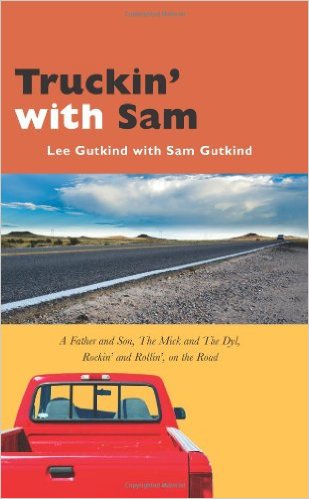
After years of thinking he’d never have kids, Lee Gutkind became a father at forty-seven and, following his divorce, soon found himself taking over more and more of the primary care responsibilities for his son, Sam. As one of a growing number of “old new dads” (recent studies have shown that one in ten children are born to fathers over forty), Gutkind realized that he faced challenges—both mental and physical—not faced by younger dads, not the least of which was how to bond with a son who was so much younger than he. For the past seven years, Gutkind’s approach to this challenge has been to spend one to two months of every summer “truckin’” with Sam, a term they define as a metaphor for spontaneity, a lack of restriction: “Truckin’ means that you can do what you want to do sometimes; you don’t always need to do what’s expected.”
What began as long, cross-country journeys in a pickup truck, including one memorable trip up the Alaska-Canadian Highway en route to a writers' conference in Homer, Alaska, have in more recent years ranged farther afield, to Europe, Australia, Tibet, and Africa. Whether listening to rock-and-roll music, entertaining themselves with their secret jokes and code words, fishing for halibut, or fighting over tuna fish sandwiches and how best to butter one’s toast, Lee and Sam have learned to respect one another. In the process of their travels and their adventures, Lee has also come to grips with the downside of middle age and the embarrassment of “senior moments,” while Sam has inevitably begun to assert himself and shape his own life. Interspersed with Sam’s own observations and journal entries, Truckin’ with Samis an honest, moving, and often hilarious account of one father’s determination to bond with his son, a spontaneous travelogue that will appeal to old dads, new dads, and women who want to know more about how dads (and sons) think and behave.
Praise for Truckin'
“In this funny and moving tale about the long strange trip that is fatherhood, Gutkind offers readers a precious truth—that it is only through the eyes of our children that we see ourselves clearly.”
~Ariel Sabar, author of My Father’s Paradise: A Son’s Search for His Jewish Past in Kurdish Iraq
“This blazingly original memoir has just become my favorite American road story. When Lee Gutkind and his teenage son, Sam, light out for adventure on the highway, what is supposed to be a vision-quest turns into a struggle for the driver’s seat. Gutkind writes better than anyone about the heartbreaking and thrilling sacrifices of parenthood. This book is the Fear and Loathing of fatherhood—by turns hilarious, twisted, and poignant.”
~Pagan Kennedy, author of The First Man-Made Man: The Story of Two Sex Changes, One Love Affair, and a Twentieth-Century Medical Revolution and Black Livingstone: A True Tale of Adventure in the Nineteenth-Century Congo
“Truckin’ with Sam is a multilevel traveling tale that takes you around the globe in more ways than one. Lee Gutkindhas written a superb account of the father-son bond as it evolves in the heat and heart of their many adventures.”
~Lauren Slater, author of Lying: A Metaphorical Memoir
TriQuarterly Online has an interview with Lee and Sam Gutkind on their website.
Table of Contents
Table of Contents
Preface: “What’s All This Blood, Dad? I Don’t Understand!”
Acknowledgments
Prologue: Africa—July 2009
Part I. The Open Road
Portal—2004
The Evolution of Truckin’
Chasing Madness
Trapped at the Border
Listening to the Road
Wet Run
The Jack London of Rock and Roll
Hello?
Artful Charlie
The Dyl
Anticipation
Tuna Fish Trouble
Sam’s Dangerous Disease
Another Border Crossing
Buttering Toast
Father Knows Best?
The Rope Test
The “Make My Day” Syndrome
The Red Bike
Hakuna Matata
Part II . Religious Experiences
Laowai—March 2008
Creation Elation
Moshe Dann
Radio Shack
Rose
Aunt Hattie
Getting Lost and Losing It
The Big Picture
Antelope Galloping
Paul and Barbara
Bears on the Brain
Winning (and Losing) the Race
The Summit
Old Men
The Gödel Connection
Afterword by Sam Gutkind
Uhuru
Truckin’: A Final Word, by Lee Gutkind
The Evolution of Truckin'
IT ALL BEGAN in a Starbucks near Sam’s school—with a book I was reading to Sam. This is what we do after school most every day. I get my coffee, he snacks on pizza from the Italian Village across the street on Forbes Avenue in Pittsburgh, and I read aloud. We read in the morning, as well, at a diner, Ritter’s, a Pittsburgh landmark, where Sam has been eating the same breakfast almost every day since beginning grade school. Sam gets pancakes, a scrambled egg (well done), bacon, and milk. As soon as we walk into Ritter’s and settle into stools at the counter, a waitress invariably turns to Charlie, the short-order cook, and yells, “Put Sam on the grill!”
I can’t tell you how many books we’ve read together—quite a few—and it’s a real eclectic mix. We’ve read Lauren Slater’s Opening Skinner’s Box, for instance. Sam was interested in Skinner and the box in which he allegedly locked his daughter to test “operant conditioning.” Sam is a geek—he loves science and technology, so we’ve read Rodney Brooks, Stephen Hawking, Richard Preston, and Charles Darwin. But all sorts of literature intrigue him. We’ve read the Greek philosophers, large chunks of the Old Testament, and short stories and essays from John Steinbeck, Isaac Asimov, Madeline L’Engle, and Ernest Hemingway, among other writers.
Once, a woman approached our table in blue scrubs and stood and listened as I read “Indian Camp,” a story in which Nick Adams, a character Hemingway based on himself, observes his father deliver a baby to an Indian by caesarian section only to learn that the newborn’s father has committed suicide during the procedure. When I finished, she said,“My dad read me ‘Indian Camp’ when was I was young and I decided right away I would become a doctor. It inspired me. Your son will be inspired by something you read to him, too, one day.”
In The Car, a young adult novel by Gary Paulsen, the book that initially inspired our truckin’ experiences, teenager Terry Anders is abandoned by his parents with a few dollars, a couple of loaves of bread, and a “kit” car his father was in the process of building, called a Blakely Bearcat, which Terry nicknamed “the Cat.” Terry finishes building the Cat and begins driving to Portland, Oregon, to search for a long-lost uncle. On the road, he meets two nomadic Vietnam vets, Waylon and Wayne, who quiz him about literature, history, and contemporary American culture: Terry is clueless. Wayne and Waylon conclude that he needs to be educated—to see America—so, on the spot, they propose to take him “Truckin’.”
Before The Car, Sam and I already had the habit of driving around the city aimlessly, listening to the radio, a routine we still follow even now with Sam at eighteen, but back then we finally found a word or a metaphor for it: Truckin’. And with the word, the possibilities became more vivid—at least to me. We weren’t just seeing sights when we were driving around, I told Sam; rather, we were truckin’—as in the classic song of the same name by the Grateful Dead:
Truckin,’ got my chips cashed in.
Keep truckin’, like the doodah man.
Together, more or less in line, just keep truckin’ on.
I assumed that Waylon and Wayne were Deadheads—and I made the connection for Sam by talking in depth about the entire rock-and-roll era, beginning with The Grateful Dead but moving expansively back and forth in time.
So from that point onward, Sam and I went truckin’, taking longer and longer sojourns, listening to those whispering echoing sounds of my past—Mick Jagger, Jerry Garcia, Bob Dylan, Jim Morrison. Sharing their music with Sam, it seemed as if I was just this moment discovering them myself. Dire Straits. Mark Knopfler. The music was turning me on all over again! Why—when—had I stopped listening? I wondered. How could I have forgotten the compulsive passion of these tunes that had once so inspired me?
Whereas I was prone to sing along with the music, sometimes at the top of my lungs, Sam consumed it all in silence. He was happy to talk about the artists—personal details about the vocalists and the bands—but avoided conversation about the sound and the lyrics. It put him in a trance. As to the “Truckin’” song, the concept interested him much more than the song itself. Truckin’, I told Sam, could be interpreted as a metaphor for spontaneity—a lack of restriction. “Truckin’ means that you can do what you want to do sometimes; you don’t always need to do what is expected.”
“Like taking a shower?” Here he saw a way out of a responsibility he found annoying and senseless.
“Well, it is important to shower every day; it’s an unavoidable thing that people do. Like breathing. Eating. You keep yourself clean. But, if, one day out of the blue, you decide not to shower, well? So?”
“So you’re truckin’,” said Sam.
“Breaking the rules. Changing the pattern. Going with the flow.”
“Like watching Volcano,” Sam said.
This was Sam’s favorite movie of the moment. We were into disaster movies at the time. We watched all of the Airport movies made in the 1970s (five of them) along with Dante’s Peak, The Towering Inferno, and Twister—repeatedly—and then we talked about them incessantly, mostly about how stupid and unlikely they were. In Volcano or Dante’s Peak, the stars, Tommy Lee Jones and Pierce Brosnan, respectively, could outrun or come dangerously close to rivers of lava, thousands of degrees hot, showing hardly any effect. “They should be boiling! They should be dead and disintegrated, and they are not even sweating!” we would yell at the TV monitor. “Why are they stopping to kiss [the leading ladies were Anne Heche and Linda Hamilton] when they could be saving thousands of lives?”
What always amazed us about these disaster movies is how quickly and neatly they ended. In Volcano, hundreds of thousands of people are probably dead, the city of Los Angeles is in ruins and it will take a quarter century to rebuild it, but now it is raining, which magically cools down the lava, and Tommy Lee Jones and his teenage daughter, who had been working in a hospital caring heroically for casualties during the disaster, are holding hands, while Anne Heche and Tommy are smiling and looking at each other in that very alluring way—a promise of passion in Joy City in the very near future.
All of which brings me back to this afternoon at Starbucks when I began to hatch a plan to make the idea of truckin’ a reality—an on-theroad adventure for Sam and me to share on a number of levels—a multiple bonding experience—music, reading books, male camaraderie, with a little geography and history, educational components, rolled into the package.
For a while, I began to think about recapturing my motorcycling days by buying a new BMW and truckin’ on two wheels. I had sold my old BMW, the one that had taken me all around the country while working on a book about the motorcycle subculture, a few months after Sam was born because, quite surprisingly and suddenly, after two decades of riding, I didn’t feel safe anymore. Motorcycling became scary—a gamble not worth the danger.
Every time I got on my motorcycle, I began to think that something terrible was going to happen, that I would smash up and die before I saw Sam, again. Or worse, I’d be mangled and twisted in an accident, and then I’d be wheelchair-bound, a quadriplegic. who could only talk to Sam by blinking my eyes or biting on a computer cable and transmitting artificial voice sounds—a Stephen Hawking–like figure, without Stephen Hawking’s fortitude and intelligence. So motorcycles weren’t in the cards for Sam and me, but I concluded that if I was really going to entice Sam into truckin’, which I suddenly seemed to be doing, it would have to be in the right way and in the right vehicle, which was, necessarily and undeniably a truck.
Everything that happened in Starbucks from that point on just seemed to happen spontaneously, although I have to admit that there was a certain amount of scheming behind it. We were sitting there, Sam and me, talking, and while we were talking, I snatched a discarded newspaper from an adjoining table and leafed through the pages in the Want Ads section. I hadn’t discussed this idea—I hadn’t even worked it out in my own mind. But I was responding to this nugget of an idea of cementing my relationship with Sam.
My eyes were on the Used Trucks for Sale section of the paper. I spotted an ad for a 1998 Ford Ranger four-cylinder pick-up, very clean, only used for gardening, and I showed it to Sam as I slipped my cell phone out of my jacket pocket and punched in the phone number, all at once, but casual-like.
Jeff—the owner of the Ranger—was home, working in his garden. “He’s a middle-school teacher,” I tell Sam. I am talking with Jeff and Sam, back and forth, Jeff at home, Sam beside me. “Jeff once taught at St. Edmunds,” I tell Sam. This was Sam’s school.
“Jeff says that he only uses the truck to haul mulch.” Jeff lives fifteen minutes from where we are sitting.
“We can come over and test-drive the Ranger right now, this very minute, if we want to.”